
When Baby Is Breech: Understanding ECV
By Elizabeth Baratta, PMHC-C, RYT-200, Certified Birth Doula (DONA)
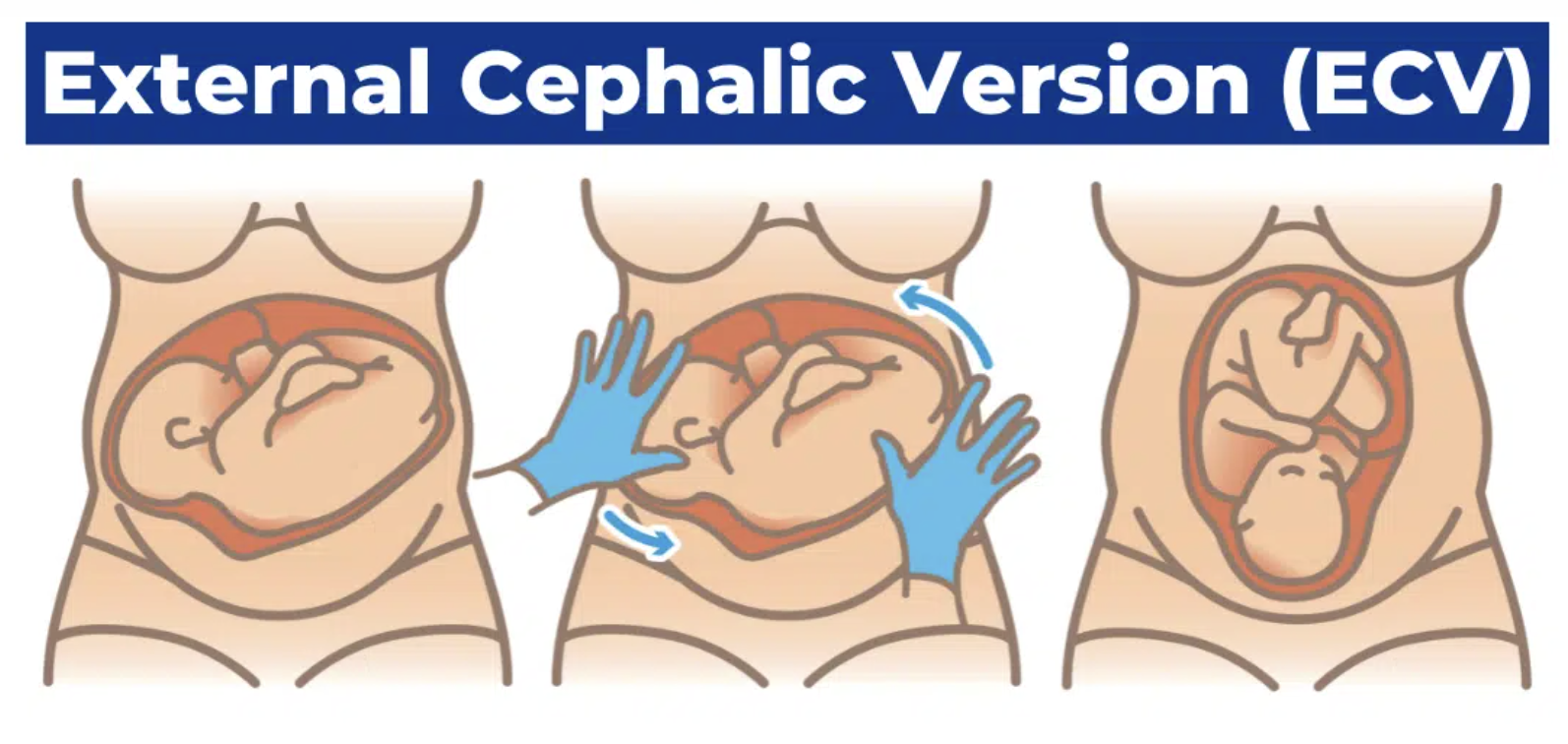
Photo source: Hypnobabies hypnobirthing
What is an ECV?
ECV, or external cephalic version, is a procedure to turn a breech baby head-down before birth. A trained provider places their hands on the outside of your belly and gently guides your baby toward a head-down (cephalic) position. Whether to have one is always your choice.
Why does position matter? Most U.S. providers no longer attend vaginal breech births, so if your baby stays breech, a cesarean is usually planned. A successful ECV can keep the option of a vaginal birth open, and successful ECVs help lower the overall cesarean rate.
Positions that may lead to an ECV
Breech positions (head up):
Frank breech: bottom down, legs straight up
Complete breech: bottom down, knees bent, feet near the bottom
Footling breech: one or both feet positioned to come out first
Other positions (not technically breech, but a version may also be offered):
Transverse lie: baby lies sideways across the uterus
Oblique lie: baby is at an angle, neither fully sideways nor head-down
What does the evidence say?
For a deep dive, we recommend Evidence Based Birth podcast episode 173. A few highlights:
According to Evidence Based Birth, approximately 20–30% of people who are eligible for an ECV are never offered one. Educating yourself and asking your provider directly matters.
An ECV may be offered before term (around 34–37 weeks) or at term (after 37 weeks). Each timing has trade-offs worth discussing with your provider.
Most U.S. insurance plans treat ECV as part of routine prenatal care, so hospitals often are not separately reimbursed for the staff time, monitoring, and medications involved. This can shape how readily it is offered.
Interestingly, the biggest factor in how painful people remember an ECV being is whether it worked. Successful procedures tend to be remembered as less painful.
What to expect
The hands-on part of the procedure typically lasts from about 1 to 20 minutes.
You and your baby are monitored before and after, so plan to be at the hospital for a few hours.
Pain relief options include an epidural or spinal (which research links to higher success rates), nitrous oxide, and IV pain medication. Relaxed abdominal muscles give your baby more room to turn.
A local note for Boston-area families
As doulas, we have seen that Boston-area hospitals (Mount Auburn, Winchester, Beth Israel, Brigham, and MGH) each handle ECV a little differently. Some offer a lot of flexibility and personal autonomy around the procedure. At others, the protocol is that a term ECV done with an epidural, if successful, flows directly into an induction rather than waiting for labor to begin on its own.
Because protocols vary, the hospital you choose early in pregnancy can shape your options later. And remember: it is always okay to change providers or hospitals if something doesn’t feel aligned with your needs and autonomy.
Questions to ask if your baby is still breech at 32–34 weeks
Who performs ECVs here, and what is their success rate?
What pain relief options do you offer for the procedure?
If the ECV works and monitoring looks good afterward, can I go home and wait for labor to start on its own, or is an induction your protocol?
If the ECV doesn’t work, what happens next?
Who isn’t a candidate?
An ECV isn’t right for everyone. Providers commonly advise against it with:
Uterine abnormalities
Twins or higher-order multiples
A previous cesarean with a classical (vertical) incision
Signs of fetal distress or an abnormal fetal heart rate
Low amniotic fluid
Certain maternal health conditions, such as hypertension
Your provider will review your specific situation with you.
If baby stays breech
So much of birth is beyond anyone’s control, and your baby’s position is one of those things. We have walked alongside clients who deeply hoped for a vaginal birth, felt real frustration and disappointment when baby stayed breech, and then used their remaining weeks to make peace with a different path. In the end, they met their babies with joy, on baby’s terms. Sometimes it’s the first reminder that baby is in charge.
How your doula can help
Your doula can help you prepare questions for your provider, think through whether an ECV feels right for you, and support you toward a safe delivery, whatever shape it takes. Have questions about a breech baby? Reply to this email or reach out anytime.
Disclaimer: Doulas are not medical personnel and do not diagnose, perform any medical exams or clinical tasks. Information presented above is not intended as a substitute for the medical advice of a properly licensed health care professional.