
Bringing in the Skill of Mindfulness for Birth and Beyond
By Betty Baratta, LMHC, PMH-C, RYT 200
In some ways, the process of birth is straightforward. Once you are pregnant (yes that in itself can be a long and challenging road for many). But once you are pregnant, you yourself don’t have to do anything really for this baby to grow beyond taking care of yourself. You don’t have to figure out how to grow its heart, fingers or earlobes! And that’s a good thing, right? Because how would you find time for all that! It’s all part of a process that is happening in this amazing body of yours. When the body is ready (or actually when the baby is ready), the pituitary gland in the brain sends powerful messages in the form of oxytocin to the uterus and labor begins. "Typical" birth (the kind most are imagining) includes early labor, active labor, and pushing the baby out. Although there are variations and each birth is quite distinct and varied. It is the same process for hundreds and thousands of years. So what is the worry then? Whatever your answer is; pain, fear, the unknown… mindfulness is an approach that can hold all of those things.
There is endless information about the “what” of pregnancy. We have hospital classes, books, girlfriends, sisters, mothers and aunts, google, Instagram, Tik Tok…. like I said, it’s endless. Most people in fact, and definitely the people who are seeking support from Boston Area Doulas, are well-informed about their bodies and the birth.
So that brings us to the “how” of birth, as in “how am I going to do this?” Mindfulness can answer the how of birth. Mindfulness is an evidence-based skill, heavily researched in regard to overall wellbeing and stress reduction. And it’s the perfect fit for managing fear, self-efficacy in birth and increased positive feelings about one’s birth experience. Some of the key attitudes of Mindfulness are Non-Judging, Patience, Beginner’s Mind, Trust, Non-striving, and Letting Go / Letting Be. Jon Kabat Zinn, a leader in the field can best define these here in this 2 minute video.
Taking a Mindful Approach to Birth
So how then can we take a mindful approach to birthing? Well there is so much expectation, plan making, and striving in birth that it is the perfect time in one’s life to retrain the brain. And the bonus here is that it will come in handy in parenting which has lots of “contractions” and lasts a lot longer than the temporary experience of birth :)
The practice is cultivated by a sitting meditation to practice being with “what is” and observing the mind. If you begin to observe it, you will see that it is either going in the past; reviewing, ruminating about what your doctor said, what happened yesterday with your friend, or it’s moving forward into the future; worrying about the ultrasound for tomorrow, perhaps creating a story about that, and then judging oneself for having these thoughts. And none of those thoughts are happening right now. In mindfulness practice we continually come back to the through the anchor of the breath. And, you’ve heard that you might use your breath in labor, right? It is your primary anchor to grounding in your body, and your anchor to this moment, right here right now.
When you are at the precipice of labor, yes there are so many unknowns and so naming that and getting comfortable with that is a mindful approach. Other ways to take a mindful approach are using a “due window” of 4 weeks as opposed to one day. Start getting comfortable saying, “around the end of March”, instead of March 25th. As a doula I can’t tell you how many clients feel disappointed about their “due date” having come and gone. Why does that happen? Because they have an expectation (conscious or unconscious) that they will have their baby on or before their due date. What if we just went with “don’t know, she’ll come when she comes”. It can be a powerful practice.
Mindfulness when dealing with pain
To give you another taste of a mindful approach to birth, let’s look at pain. There is no avoiding having to manage some pain in the process of birth. Pain medications are there for support, and work well and also each birther who is having a vaginal birth will manage some contractions before getting pain medication.
So ask yourself, what is pain? Is pain good or bad? What are the ways we know something is wrong in the body? And then, what about the pain of childbirth? Does that fit into the regular category of pain? No, it is Transformational Pain. Nothing is wrong, it’s all quite normal, and it means a transformation is happening, a biological process and quite quickly in fact. There are other times that these biologic processes take place; in infancy with teething, in adolescence with hormonal and bodily changes and how can we forget menopause!
Back to pain… there are three components of pain.
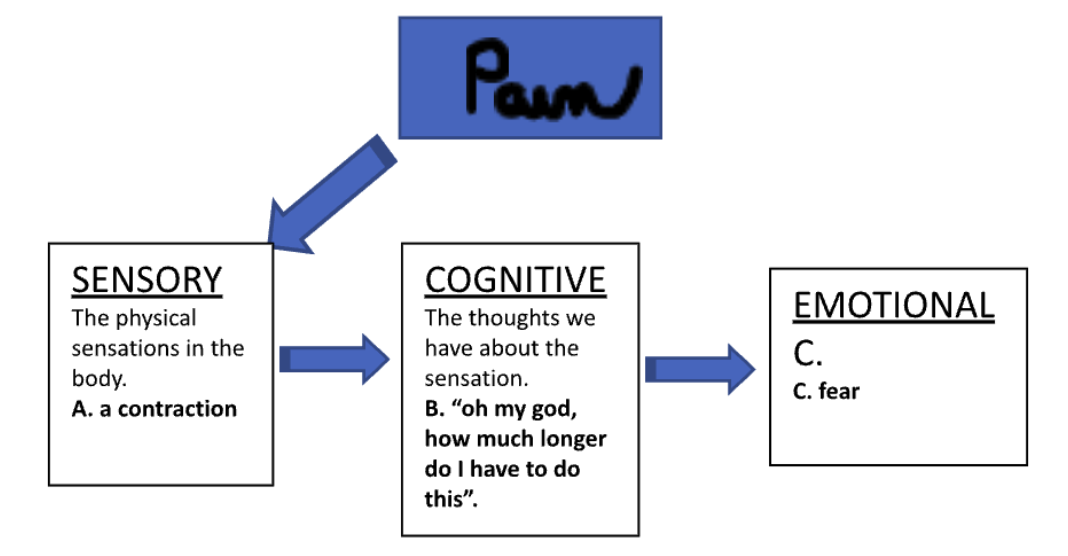
In mindful birthing we work towards uncoupling the cognitive and emotional pieces from the physical sensations of pain. How do we do that? By staying in this moment, right here, right now.
Another way to say all this is…